Growing up in Miami, as a Venezuelan surrounded by Colombians, Argentinians, Cubans, and Nicaraguans, fútbol (or soccer or football) was the sport you put your kid in. This was not an optional thing to care about. I can tell you where I was and how I felt during every World Cup from 2002 onward, the way you might remember a close relative’s birthday.
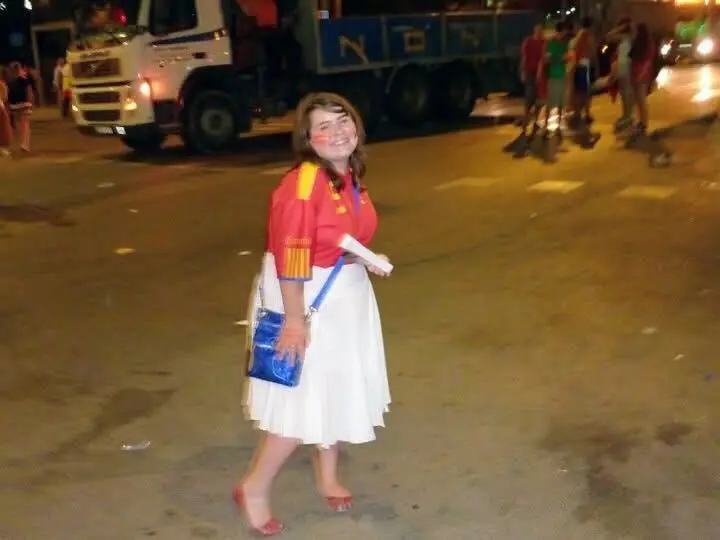
One of my core memories was made at 16 while visiting family in Madrid and watching Spain win the World Cup for the first time in 2010. I remember running out of my aunt and uncle’s apartment with my cousin, dancing through Cibeles, cheering and crying with strangers because “we” had won. It was both the most irrational and communal experience of joy I had ever had. I suddenly had thousands of friends.
This is fútbol at its best. It gives billions of us a shared language, ritual, grievance, and reason to scream together.
So, flashing forward to the 2026 World Cup, something that had once brought me so much joy now felt compromised by the same extractive forces that we in the philanthropic field grapple with every day: greed, spectacle, corruption, state power, displacement, and the willingness of institutions to bend around the powerful. In this World Cup alone, there have been many instances of corruption, from Trump calling the FIFA President to overturn a red card decision for a U.S. player, to Iran’s team being denied visas, obligating them to commute from Tijuana and endure targeted security checks for their own games. And before the confetti was swept up from the final game, FIFA announced a plan to sell a 20% stake – valued at $20 billion – in future tournaments to a private equity firm tied to the Kushner family, inciting immediate backlash and resulting in a boycott of future events from over 50 countries, including the recent World Cup winner.
Those forces have always had their fingers in the sport – the most commercialized sport in the world – but, over the last decade, they have become harder to ignore. The thing I had loved since childhood felt contaminated.
But here is what I have to admit: the contamination has always been there, and I’ve never stopped watching. Despite fútbol being one of the most financialized sports in the world and a hotbed of corruption, the joy and community keep breaking through. I felt it again this year, watching Spain win again at a bar in Chicago with my brother – screaming, celebrating with strangers, and, briefly, feeling like I was 16 again. I have never been able to stop loving this sport, even when I can clearly see how messy and corrupt it is.
The things people love do not exist outside of capitalism, nationalism, exploitation, or state power. Neither do the places where people gather. Mass culture is compromised because the world producing it is compromised. Waiting for culture to become politically pure before taking it seriously means waiting forever – and abandoning significant opportunities to reach and organize people. Parts of the political left have confused distance from popular culture with political sophistication, or, worse, used that distancing to lazily maintain a superficial kind of ideological coherence and purity. But ideology divorced from culture can’t be pure nor coherent – because it’s nonsense.
The World Cup is one of the clearest examples we have. It shows clearly, perhaps painfully so, that popular culture is contestable political terrain.
The World Cup creates a temporary “we.” That “we” is not automatically good. Mass feeling can perpetuate nationalism, racism, xenophobia, homophobia, machismo, transphobia, and exclusion. It can be bought and sold, reduced to brand loyalty and sold as a $100 Messi or Haaland jersey and a $20 stadium beer. It can provide spectacle, effectively distracting us from the conditions that make communal sports experiences so desirable in the first place. But underneath the spectacle is something real and deeply human – the mass feeling of the temporary “we”. That “we” is not automatically bad either.
The World Cup is possible because there is a widespread human desire for belonging and global connection. FIFA did not invent that desire – it has exploited it for almost 100 years. Corporations monetize it, countries manipulate it, but none of them can rightfully claim the desire itself. That desire is intrinsically linked to human nature, which, more often than not, bends towards finding joy and community, especially in times of economic and political uncertainty.
People want ritual, memory, joy, and a reason to gather. They want a side. They want to experience themselves as part of something larger than their individual lives in a moment when we are more isolated and disconnected than ever before. They want an uplifting human experience and an underdog story. That desire is politically powerful, and the right understands it far better than much of the left does.
The right does not wait for people’s attachments to become ideologically aligned before taking them seriously. It enters the places where people already feel pride, loyalty, nostalgia, grievance, masculinity, fear, and belonging, and gives those feelings political meaning.
We see that play out all around us: the NFL, military flyovers, flag ceremonies, country music, churches, combat sports, and language that invokes the protection of a “way of life.” The right has spent decades presenting itself as the natural home for these parts of ordinary American culture.
Its message is emotional before it is analytical: your attachments are valid. Your pride is legitimate. Your traditions matter. And then it pivots to: your way of life is under threat. You belong with us, and we are the people willing to defend you.
The stories built around those feelings are usually xenophobic – exclusionary, reactionary, manipulative – and demonstrably false. The right is selling fear – and it does so in part by not dismissing these feelings or attachments as unserious, nor by sneering at what’s broadly consumed or liked.
Parts of the left do the opposite. We begin by correcting the feeling, distancing ourselves from it, or explaining why the thing someone loves is actually problematic. We ask people to arrive with the right analysis before we offer a relationship, a political home, or any evidence that we take their material lives seriously, let alone design a path to heal some of the harm that they’ve experienced.
We consistently say we believe in the grassroots. We say we want to build a broad, multiracial democracy rooted in ordinary people. But too often, we treat the places where ordinary people actually experience belonging with suspicion or contempt.
We sneer at “sportsball,” fandom, flags, patriotism, sentimentality, and popular pleasures that seem commercial, nationalistic, unsophisticated, or insufficiently radical. We like “the people” as an abstraction but are uncomfortable with people as they actually are: contradictory, emotionally excessive or volatile, hypocritical, attached to imperfect institutions and people, or wholly unfamiliar with the language that we decided signals moral or ideological seriousness. People are messy, imperfect, sometimes cruel, but that doesn’t mean we should abandon them in hopes of engaging politically developed and fully realized individuals (who don’t actually exist).
The American left celebrates the idea of the masses while remaining embarrassed by mass culture. But if we are serious about being grounded in the grassroots about actually building the multiracial democracy we say we are about, we have to begin with people as they are. We have to engage the places where they already celebrate, grieve, and experience themselves as part of something larger and do so without contempt or patronization.
This does not mean the left needs its own manipulated nationalism, or that every sporting event should become an organizing opportunity. It doesn’t mean we should broadly accept people who continue to perpetuate harm. It simply means that popular culture is political terrain, whether we engage with it or not. Choosing to engage is what makes it contested terrain – fought over, emergent, winnable, loseable. Winning and losing can be done honorably, smartly, luckily, unluckily, or gracefully. Choosing not to engage isn’t really losing; it’s forfeiting – can you really say you lost if you didn’t even show up for the game?
[P]opular culture is political terrain, whether we engage with it or not. Choosing to engage is what makes it contested terrain – fought over, emergent, winnable, loseable.
Fútbol’s own history makes this clear. The same sport used for spectacle and pacification has been a platform for cultural resistance, democratic practice, and anticolonial struggle over and over again. From 1939 to 1975, Franco’s regime used the sport as a symbol of Spanish national power and controlled cultural identity. In the 1970s, Basque and Catalan players and supporters used the pitch to resist the regime’s repression of their languages and cultures by protesting political executions and bringing out their banned flags onto the pitch.
In 1980s Brazil, Sócrates and his Corinthians teammates practiced workplace democracy within their club and used their shirts to advocate for elections when the country was under a military dictatorship. Ahead of the 1958 World Cup, Algerian players left successful careers in France to form a national team for a country that was not yet recognized, carrying their cause and case for independence around the world.
These players did not wait for the game to become less messy. They took a human celebration of body, beauty, loyalty, discipline, rage, and joy and gave it a political shape. They connected feeling to organization, strategy, risk, and a struggle much larger than a 90-minute game.
When the left withdraws from popular culture because it is commercial, nationalistic, inconsistent, or culturally uncouth, we do not make that terrain neutral. We leave its symbols, rituals, pleasures, and enormous emotional power to corporations, states, authoritarians, and the right to mold and assign a narrative to.
I often think about this dynamic in the work we do at Ktisis and in progressive philanthropy, because progressive philanthropy often creates a similar distance from ordinary people.
Philanthropy is not short on feeling. There is guilt, hope, moral clarity, fear, urgency, generosity, inspiration, and sometimes rage. We know how to professionalize feelings into communication. We are much less practiced at organizing it into durable relationships, collective identity, leadership, action, and power.
The right gives people a story about who “we” are, what happened to us, who is responsible, and what we should do together. Progressive philanthropy often responds to mass politics with sensemaking and partial coordination: a landscape scan, a risk memo, a convening, a communications plan, or a really pretty theory of change with lots of ecological metaphors.
Those tools are important, but they cannot build a base. They cannot substitute for trust, political education, shared risk, leadership development, and the slow relational work required to build sustainability. Organizing means meeting people where they are and staying long enough to build trust. It means giving people repeated opportunities to make decisions, take action, fail, learn, return, and act again. It means respecting people enough not to demand that they become culturally recognizable to us before we consider them worth organizing alongside.
No mass movement will be built only with people whose politics are already fully formed or aligned with us. If we believe in grassroots power, we have to believe in the actual grassroots: people who arrive with family stories, national attachments, religious traditions, imperfect language, contradictory desires, problematic favorites, and loyalties that do not fit neatly into any one movement.
That does not mean accepting every belief or romanticizing every form of popular culture. Organizing people as they are does not mean leaving them exactly as they are. Political work requires argument, challenge, education, and transformation. We are all continuously moldable.
But transformation cannot begin with contempt; that’s the lesson I want us to take from fútbol. The World Cup shows that people are desperate to belong to something larger than themselves. Identity is not a policy category. It is sung, worn, inherited, argued over, cried through, and passed down. It’s not fixed; we mold and change it.
When people ask why I care this much about a game whose corruption and power struggles I can see clearly, my answer is not that I am naive about who profits and who gets crushed. The joy and human connection I feel and experience are the whole point.
The crowded bars, the team rituals, the millions of us screaming at the television, the half of the country who chose to watch in Spanish because that is where the game feels most alive, the many conversations with strangers – none of that is separate from politics. These are the people we want – need – to reach: they are our constituencies and potential partners in change, the people from whom any genuinely mass movement that can deliver lasting social change must be built.
The question is whether we leave that feeling to be sold back to us as spectacle, used to pacify, or directed toward exclusion, or whether the left is willing to enter the world people already inhabit and do the slower work of building relationships, political understanding, and shared power from there.