

📷 credit: Pexels
Here’s a pattern most of us in philanthropy know well: something isn’t working, so you hire a consultant, run a planning process, and six months later you have a document (a strategic plan, a refreshed framework, whatever the latest vernacular is). And then not much changes. The same tensions resurface, the same decisions stall, and 18 months later you’re back in a planning process.
The problem isn’t that strategy is useless. It’s that strategy is one leg of a three-part system, and the other two, operations and culture, rarely get the same attention. Until all three are functioning, the strategy document stays a document. For those of us in philanthropy, the cost isn’t just organizational frustration — it’s resources for justice that move slower, later, or not at all.
I’ve watched this cycle across organizations from $1 million to over $100 million in budget from most of the seats in the room: entry-level fundraiser, program staff, and chief of staff and head of fundraising at a national fund. As an individual contributor, I felt how operations and culture shaped my ability to do good work. As a leader, I saw how they shaped everyone’s. Often, the strategic plans of these organizations had little to say about how they would execute the strategy, or whether the culture could sustain it. This piece is about that gap.
The limits of strategy
Strategy tells staff and board what the organization is trying to accomplish and how. But the how that strategy answers is the logic of the approach: which activities we’re choosing, and why we think they’ll succeed.
What strategy doesn’t include is the other how — the machinery of the organization. It doesn’t tell you how decisions actually get made or ensure institutional knowledge survives staff turnover. And it doesn’t shape the behavior around those systems: whether candor is rewarded or quietly punished, whether people trust the process (and each other) enough to flag problems early, and whether they route around official channels. Those are operations and culture problems, and no amount of strategic clarity will fix them. Conflating the two hows is often why organizations convince themselves a finished strategy means the work is done.
A strategic plan, a theory of change, and a priority framework are easy to bring to a board meeting. Operations and culture produce capabilities instead: decisions get made faster, ownership becomes clearer, knowledge survives turnover, people say the hard thing early and disagree in the meeting instead of after it.
Strategy has one more advantage: it produces artifacts. A strategic plan, a theory of change, and a priority framework are easy to bring to a board meeting. Operations and culture produce capabilities instead: decisions get made faster, ownership becomes clearer, knowledge survives turnover, people say the hard thing early and disagree in the meeting instead of after it. None of it translates easily to a slide deck.
That asymmetry is why organizations default to strategy when something isn’t working — it’s the easiest intervention to see moving.
The three legs
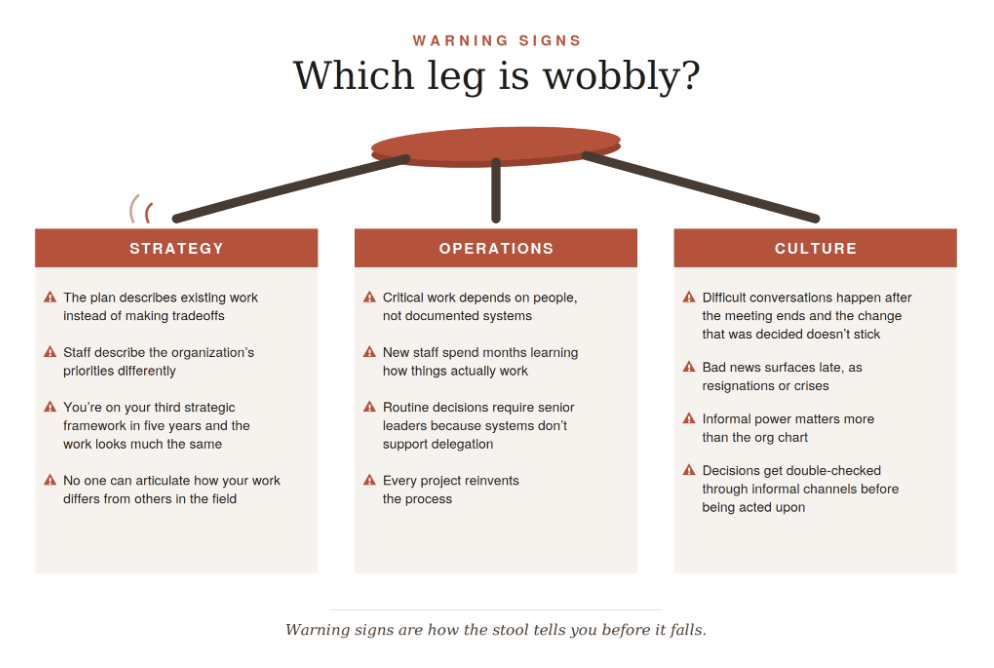
Think of it as a three-legged stool. Each leg does distinct work, and the stool stands only if all three are functional.
Strategy sets direction. It answers: what are we trying to do, how, and importantly — what are we not doing. Real strategy requires tradeoffs. If nothing was cut or deprioritized in your last planning process, you probably produced an inventory of current work, not a strategy. If you added work without changing your structure or revenue model, you were dreaming–not strategizing.
Operations is the infrastructure that turns intention into action: decision rights (who actually has authority to decide what), ownership (who is accountable versus merely consulted), workflows (how work actually moves from idea to completion), institutional memory (what the organization knows independent of who is currently on staff), and more. This is not just HR policies and accounting systems, but rather the mechanics that move strategy into execution.
Culture is the behavioral patterns that determine whether the other two legs hold. Those patterns aren’t set by values statements–they’re set by what leadership consistently rewards, tolerates, and corrects, intentionally or not. You can document every workflow and clarify every decision right, but if people skirt the systems, defer to whoever has the most informal power, or wait to see what the ED wants before committing to a position, the ops infrastructure exists on paper and gets ignored in practice. Culture also shapes the quality of strategy: organizations where honest dissent is genuinely welcome produce better strategy.
The most common failure mode is strategy without the other two. But each combination has its own failure signature: Strategy without operations is a document. Operations without culture is a system nobody uses. Culture without strategy is a great team pulling in different directions.
What this looks like in practice
A note before the examples: we’ve seen these patterns in our projects with foundations and other clients, but that work is usually confidential. So, in the spirit of building the field, we’re sharing two examples from our own team, plus one from a client who gave us permission. We invite you to consider the parallels in your organization or other spaces you are in.
Money out the door. Money delayed is strategy delayed.
One of our clients is a national fund that moves money to local grassroots organizations in key states. Its strategy is to move money early and year-round, because early money compounds — groups can staff up, plan, and build instead of scrambling in the final weeks of a cycle. Timing wasn’t a feature of the strategy; it was the strategy.
Money moved when it happened to arrive, not necessarily when it would have the greatest impact. Culturally, both teams were deeply mission-driven, but coordination depended on ad hoc conversations rather than a shared management rhythm.
Operationally, however, there was no reliable, organization-wide revenue forecast. Development and grantmaking ran on parallel tracks, so in a cycle where the organization granted roughly $140 million, program leaders had no dependable way to know whether to plan around another $30 million or another $60 million. Money moved when it happened to arrive, not necessarily when it would have the greatest impact. Culturally, both teams were deeply mission-driven, but coordination depended on ad hoc conversations rather than a shared management rhythm.
That reframed the question from “Is the strategy right?” to “Can the organization see far enough ahead to execute it?” The organization built a documented revenue forecast, introduced recurring planning between development and program, and created grantmaking scenarios tied to different fundraising outcomes, with predefined decision points as revenue crossed specific thresholds. The priorities came from the strategy; the thresholds turned them into decision rules. Dedicated development-operations and program-operations functions made coordination someone’s responsibility rather than everyone’s aspiration. Leadership reviewed revenue and grantmaking together weekly, and dashboards let everyone in the organization pull up real-time numbers. The strategy didn’t change. The organization had built the operational capability and the management discipline to carry it out.
Now two examples from our own team. For context: Ktisis exists to mobilize resources for racial, social, economic, and environmental justice, and our own infrastructure has to hold that work. We’re five years old, founder-led, and moving from “small enough that staff can hold it in their heads” to “large enough that they can’t” — a prime moment for the three legs to start wobbling. Foundations and family giving structures have their own versions: a liquidity event that unlocks a new tranche of grantmaking, a change in longtime staff leadership, or a generational handoff on the board.
Timesheets. We almost made a hiring decision on numbers we couldn’t trust.
The strategic choice here is the business model itself: Ktisis provides consultant time on client work, so utilization is the load-bearing metric. We’d set a target of 60–70% of consultant time on client work, but our systems never surfaced the actual data, so we had no way to check ourselves against it. Operationally, our timesheets weren’t built to measure time accurately: people completed them, but each in their own way, with no standard and no review to catch the drift. Culturally, our norm was to let conversations rather than evidence drive staffing decisions, and we nearly hired on that basis.
What stopped us was reviewing six months of data at once: most people weren’t hitting the 60% threshold on any regular cadence. That reframed the question from “who do we hire to add capacity” to “why isn’t the capacity we already have reaching client work.” We fixed both the data and the norms: weekly timesheets, required manager sign-off, and a monthly review cadence. The result is that we can now see where consultant time actually goes and shift it toward client work before gaps compound. And because utilization numbers only tell part of the story, we’re building qualitative signals into the same rhythm, such as staff feedback and client reviews, so growth decisions read the health of all three legs, not just the math.
The Ktisis Way. We had a way of working. It just lived in people’s heads.
The strategic choice was to become a firm rather than a founder’s practice. The vision that followed was compelling: capture how Ktisis works, what we believe, and the practices that make us distinctive in one resource called The Ktisis Way.
A small example of how that gap surfaced: in the six-month timesheet review above, almost everyone was logging volunteer hours, except our two newest hires. Ktisis had a volunteer time policy; they’d just not known of it, because it wasn’t in the onboarding.
But the real cost was growth, not a missed policy. Our consulting is bespoke, but bespoke isn’t improvised, and there was no shared foundation underneath the custom work: no intake process, no debrief practice, nothing that captured how Ktisis approaches an engagement. So every engagement ran through our founder, even though our consultants are senior philanthropy leaders capable of running their own strategy. That worked when we were small enough for one person to hold it all. As we grew, it couldn’t: finances, billing, policies, and client practice all needed named owners, but the resource that would have made ownership visible had stalled. Culturally, the project had become everyone’s responsibility, and therefore nobody’s.
That reframed the question from “how do we finish documenting everything” to “who needs to know what, and where would they look for it.” We split the one resource into three, each with a named owner: a finance & operations reference, an employee handbook, and a practice playbook that lets consultants bring their own judgment while staying true to how Ktisis works.
A reframe for EDs and boards
If your foundation is in a cycle of strategic planning without meaningful change in practice, the question worth asking before commissioning the next process is: which leg is actually wobbly?
If decision rights are murky and workflows live in people’s heads, more strategy won’t fix it. If the culture doesn’t support honest dissent or genuine accountability, a better operations manual won’t fix it either. And if the strategy itself is unclear, then ops and culture work won’t compensate for the lack of direction.
The reflexive answer is always more strategy. It’s legible, it produces artifacts you can show a board, and it feels like progress for the reason we started with: it’s the leg you can see. The other two leave behind something you can’t put in a board packet: an organization that makes better decisions, learns faster, and executes more consistently.
And a one-legged stool doesn’t stand.