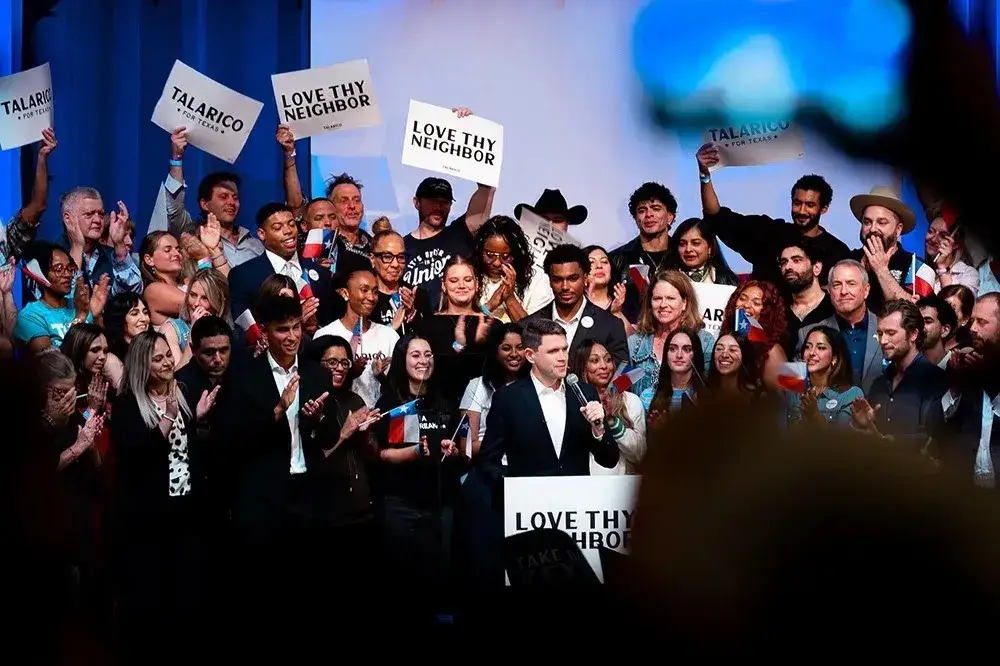
📷 credit: Movement Voter Project
November 3 delivered the biggest Democratic wave that was realistically possible. I haven’t found an operative on any side who predicted it. Democrats now hold the House, the Senate, a majority of governorships, a dozen newly flipped state legislative chambers, and more. After advising over $40 million to pro-democracy work over the past two years in partnership with dozens of individual donors, foundations, and networks like the Movement Voter Project, we’ve been deeply engaged in midterm prep and still found ourselves happily surprised by the dramatic results of this election.
Nine days on, many of us are still taking in how big this was and what it means. Here is my read on what happened, why, and what donors should be thinking about and doing next. The short version: this was a mandate for change, not an endorsement. Philanthropic investment ebbed in the face of growing doubts about the power of Trump these last two years but remained robust enough that, coupled with incredible grassroots energy and determination, a victory for democracy bigger than we could have hoped played out across the country. The next two years decide whether it becomes a lasting majority or a one-term surge.
What happened
Democrats won at every level of the ballot. This is the first time in 20 years that a sitting president has lost both chambers of Congress in one election.
| Level | Result |
| U.S. Senate | 55 D, 44 R after Mississippi was called. As of writing, Alaska is still counting and leaning Democratic, which would make the Senate 56–44. Flips: Iowa, Kansas, Maine, Mississippi, North Carolina, Ohio, South Carolina, Texas, and likely Alaska. |
| U.S. House | A clear Democratic majority, up from a 218–214 Republican House. AP had 256 seats with 9 uncalled; most projections show more than 260 Dem seats. The new majority will likely lead to election of the first Black Speaker of the House. |
| Governors | Six pickups (Georgia, Iowa, Nevada, Ohio, Alaska and Texas) leave Democrats with 30 governorships. About 75% of Americans will live under a Democratic governor. |
| State legislative chambers | 12 chambers flipped to Democrats: Arizona House and Senate, Georgia House, Michigan House, Minnesota House, New Hampshire House and Senate, North Carolina House (from a Rep supermajority), Pennsylvania Senate, Texas House, Wisconsin Assembly and Senate. |
| Trifectas | Taken together, these Gov & State Chamber flips have resulted in six new Democratic trifectas:, Arizona, Michigan, Minnesota, Nevada, Pennsylvania, Wisconsin. Additionally, Alaska will have a Democratic governor plus coalition-run legislature. |
| Supermajorities | Additionally, Democrats broke nine Republican supermajorities: Florida House, Indiana House, Iowa House, Kansas House, Missouri House and Senate, Ohio House, North Carolina Senate, South Carolina House. Democrats achieved supermajorities in the Delaware House, New York Senate and New Hampshire House. |
| State supreme courts | Democrats flipped seats on the Ohio and Texas high courts, held seats in Michigan and North Carolina, and turned back conservative efforts in Montana and Utah. |
| Election officials | Voters broadly rejected Republican candidates for secretary of state and clerk who campaigned on changing how elections are run. |
| Attorney General & Prosecutors | Democrats flipped five AG races (Georgia, Iowa, Kansas, Ohio, and Texas), all in states Donald Trump carried in 2024, and Republicans flipped none (plus Alaska will flip when the new Dem Gov appoints a new AG). Progressive prosecutors also fared well, winning all the highest-profile races from Minneapolis to Fort Worth to LA. |
Ballot measures went both ways. Voters weighed in on 146 statewide measures; some trend highlights:
- Abortion rights won. Missouri rejected a near-total ban, and Nevada put abortion rights up to viability in its constitution.
- Money in politics. Michigan and Montana passed landmark money & politics ballot measures
- Tax policy. In red and blue states alike, voters mostly showed wariness toward changes to the tax code. Washington kept its millionaire tax, but the California billionaire tax measure failed.
- Democracy measures mostly won. Virginia restored voting rights to people leaving prison, and voters in seven states sided with direct democracy (California, North Dakota, South Dakota, Utah, Idaho, Missouri and Montana). But Ohio passed a photo ID requirement, and five states (Alaska, Arkansas, Kansas, South Dakota, West Virginia) passed amendments allowing only citizens to vote.
- Anti-trans sports measures passed in Arizona, Colorado, Nebraska, and Washington, though by smaller margins than feared. A similar measure failed in Missouri, proof that a well-funded, thoughtful equality campaign can win.
Who voted and why
This was a vote against the party in power, not an embrace of Democrats. About three-quarters of voters were dissatisfied with the country’s direction, and NBC’s exit poll put Trump’s disapproval at 62%. Yet the same voters still viewed the Democratic Party unfavorably, by a net six points.
Two currents ran together to create the blue tsunami: an affordability wave most pronounced among working- and middle-class voters and a democracy wave especially among professional-class voters. This wave showed up in every single demographic. Voters of all types shifted to the Democrats – people of every ethnic background (with Latine voters surging back with a 30-point shift), men & women, every age group (with voters under 29 shifting even more by 34 points), at every education level, and in every geographic region.
What it means
It was a rebuke of Trump and his allies. Voters rejected his corrupt, authoritarian, and billionaire-backed politics. They protested the disregard for affordability, the attacks on democracy, and the grift. Above all, they kept up a pattern of voting against whoever holds power and demanding that someone make things better.
It was not inevitable. Elon Musk spent about $500 million, and wealthy Republican donors added billions more. Many attempts to undermine elections were made and thwarted. Anger over gas prices, affordability, and corruption made a wave possible, but messaging, mobilizing, and organizing translated that anger into the wave: they widened margins and pushed the edges of the map further than anyone expected. Hard-fought mobilization and resistance from the streets of Minneapolis and other cities after ICE raids to courthouses across the country defending the integrity of our elections made this victory possible.
The Senate math changed for a decade. Democratic voters are concentrated in cities, which makes the Senate map harder for Democrats every cycle as the urban/rural partisan divide and population distribution across the country shift. Only a wave like this could deliver Democrats a durable majority. A few weeks ago, the best-case scenario for strategists was a slim majority they could leverage quickly before it was lost. Now seats across the South and Plains have flipped, the Rust Belt blue wall is rebuilt, and New England’s last Republican senator is gone. Majorities in 2028 and 2030 are now far more likely, even if they shrink.
The House majority may be big enough to hold the whole party. Progressives and moderates both won, often deep into conservative territory. Republicans’ mid-decade gerrymander backfired into a dummymander. But new members must deliver results, or this becomes a one-term surge. Trump remains in power for the next two years, limiting Congressional power, and the Democratic caucus still leans moderate, meaning major progressive legislation faces an uphill battle.
The states are where the generational shift happened. From Michigan and Georgia to Texas, new trifectas and majorities create the power to govern and deliver on voters’ demands for change. They will also shape the 2030 census and redistricting and serve as the frontlines in the fight to protect voting rights. Down-ballot wins are building a new progressive bench while thinning the far right’s.
What donors should do now
The biggest risk now is complacency. Voters turned out demanding change. People are hurting, and they want government to make their lives better. They want their kids to have a better shot than they did, their voices heard, and a planet and economy that work fairly for everyone. If we answer with a return to a normal or tepid, uninspiring set of policy actions, we lose them the way Trump just did. I’m hearing from some donors that they are fired up for the coming next steps, but others have asked if now they can “shift to other issues,” which I’m actively trying to head off, as a loss of momentum now will endanger any progress on those other issues
The harms haven’t stopped, either. Anti-trans attacks are losing steam but still working. Abortion rights are not secure. Climate fights remain challenging. Racist anti-immigrant and tough-on-crime messages still land, even when their extreme versions don’t.
Here is where I think funders can make the most difference:
- Now, through certification: Fund ballot chasing in races still being counted, especially in California. Back targeted legal defense (like the Michigan Money Out of Politics ballot measure), watch certification, and push back fast on any election denial. Don’t let the lame-duck period slip by unwatched.
- Over the next two years, turn wins into governing: Support the people working out what a strong progressive congressional agenda looks like, one that meets voters’ demands with this moment’s urgency. Help new state majorities and trifectas pass laws that prove that when we hold power, we solve problems. Renew funding to frontline organizing groups so they can translate local wins into policy results. State wins can model federal action for the future.
- The long game, narrative, and reach: Invest deeply in media, narrative, and culture work so this moment carries into the debates of the next decade. Invest broadly, too. Now is the time for deep, sustained engagement there toward a progressive populist politics, not the time to write them off.
The work ahead
This wave resulted from collective outrage and collective mobilization, but we must translate it into enduring power. Voters gave us a chance to show what the government can do for them. What we fund in the next few months – and keep funding for the next several years – will decide whether this was a turning point or a blip.
If you’re trying to figure out where you fit in and what actions and giving you should undertake, please reach out; we’d love to talk.