

📷 credit: Pexels
The 2024 election left many of us asking hard questions about the future of American democracy – and our role in it. How did we get it so wrong? Why did we lose despite record-setting investments in voter mobilization efforts? What will it take for the Left to rebuild and reinvigorate its base? And, most importantly, what will it take to reorient our nation’s trajectory toward the reflective, multiracial democracy we have always needed?
Today, America faces its most dangerous constitutional crisis since the Civil War. An autocrat holds the highest elected office in the land. The federal government has been weaponized against its own people. States are being defunded due to policy or personal disagreements with the President. Congress, the judiciary, and the media face threats of persecution by the executive branch. Every day brings a new catastrophe to our doorsteps.
In the face of all of this, it is critical that we recognize the power we collectively hold to build a better future for us all. This administration is counting on us to be so overwhelmed by the daily onslaught that we become paralyzed, convinced that our investments in democracy don’t matter. Our disengagement is their priority.
The truth is, we can build power in 2026. We can fend off the authoritarian designs of this administration. We can make progress toward a democratic future. We can win – but only if we fortify our commitment to democracy in the lead up to the midterm elections.
What Can We Win in 2026?
2026 is a chance to build and defend a national state-level firewall that protects people’s rights and demonstrates what accountable democracy actually looks like. Even after the Callais decision which will expand partisan gerrymandering and erase most protections against racist gerrymandering, there remain multiple paths to build power. While chaos reigns in Washington, we can win governors’ mansions, state legislatures, and critical senate and congressional seats necessary to resist federal overreach. But to do so, we must learn the right lessons from 2024: we have to invest earlier, think structurally rather than transactionally, fund the multi-entity ecosystem, and resource the organizing infrastructure that builds power capable of withstanding all that is on the horizon.
1. Winning Back the House
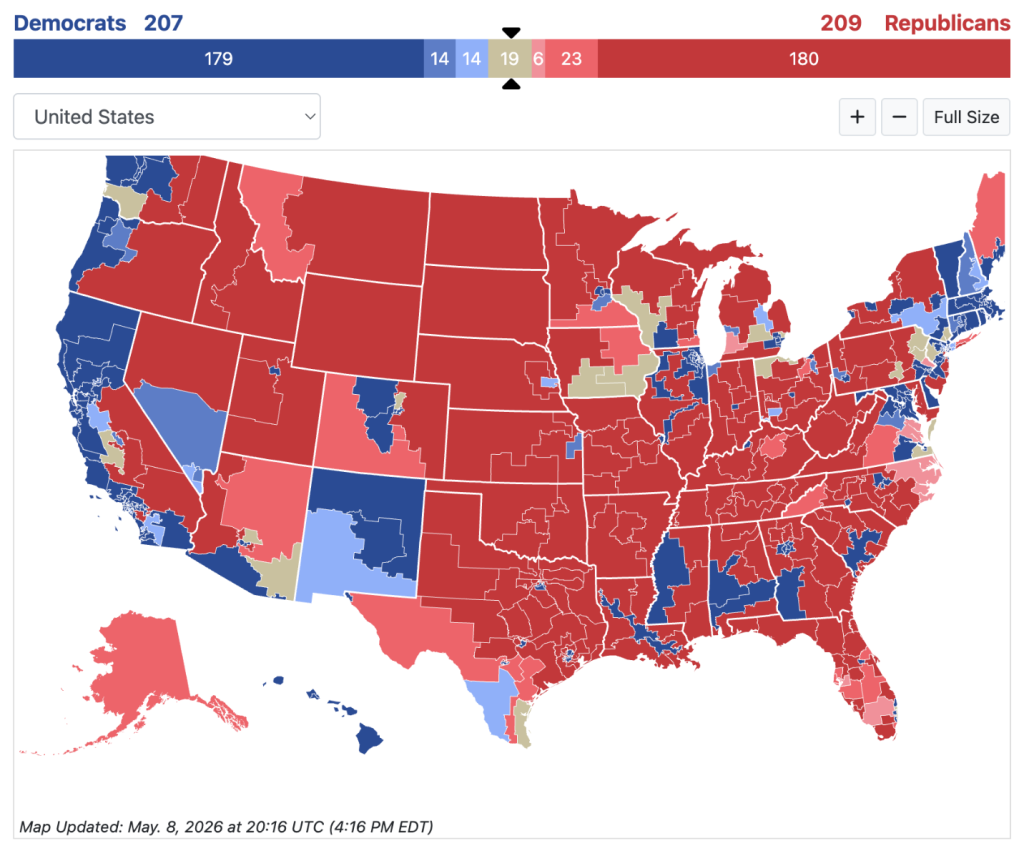
Winning back the House is both the most urgent and most achievable goal of 2026. Democrats currently hold 207 seats to Republicans’ 209 – a margin so thin that a modest wave could flip the chamber. Historical trends further strengthen the case: so-called “change elections” are the norm when it comes to the midterm cycle. With a narrow split and 19 seats rated as toss-ups, the path to the majority runs directly through districts in Pennsylvania, Michigan, Arizona, and the suburbs of major metros where the administration’s economic and social policies have generated significant backlash. Winning the House ends the rubber-stamp era for this administration’s legislative agenda and restores a critical check on executive power. The first-ever mid-decade redistricting reshuffled the political map and it got even more muddled and challenging after the Callais decision, but most projections still point to a Democratic majority after the midterms if trends continue and we all do our collective work together.
House Elections:
2. A (Narrow) Path to Power in the Senate
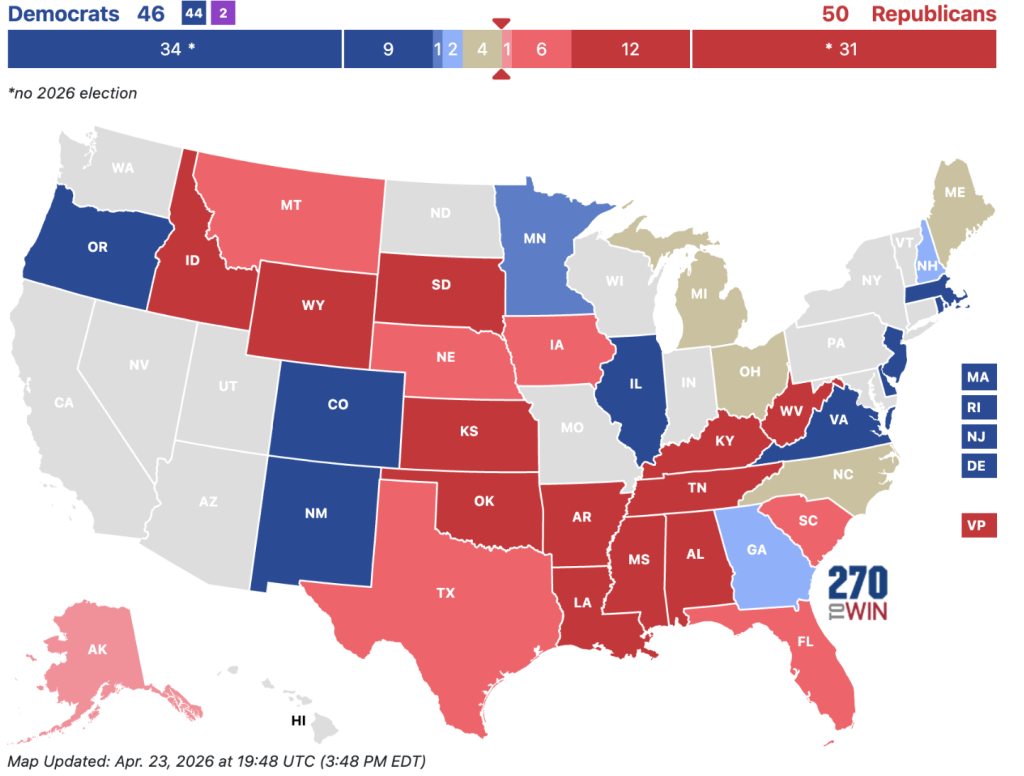
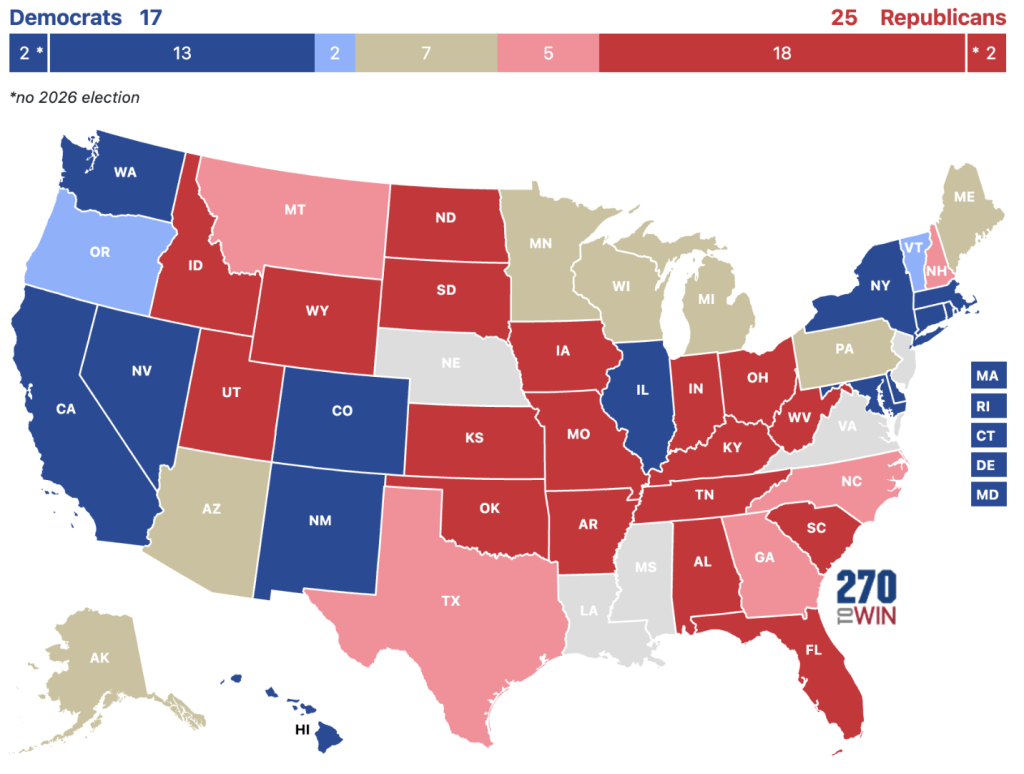
The Senate map is more challenging but not impossible. Democrats begin 2026 defending a narrow minority and must play offense in a handful of states where Trump’s approval ratings have softened. What at first seemed unattainable now feels merely like an improbable long shot. North Carolina, buoyed by a growing suburban electorate, presents a significant opportunity to flip the seat held by outgoing Republican Senator Thom Tillis. Holding New Hampshire, Georgia, and Michigan is equally critical to any path forward. Beyond these seats, flipping Maine and Ohio or even states like Alaska, Nebraska, Iowa, Texas, and Montana must also happen for the chamber to shift. Even if Democrats fall short of a majority, running up margins in these states builds organizing infrastructure that will be crucial in 2028 and beyond.
Senate Election:
3. New Opportunities (and Challenges) in the States
The Gubernatorial Map
State governors serve as a critical line of defense against federal overreach. With their control over state agencies, National Guard units, and local policy agendas, they have the capacity to fill critical gaps when the federal government falls short, including providing for the defense of communities targeted by a fascist regime.
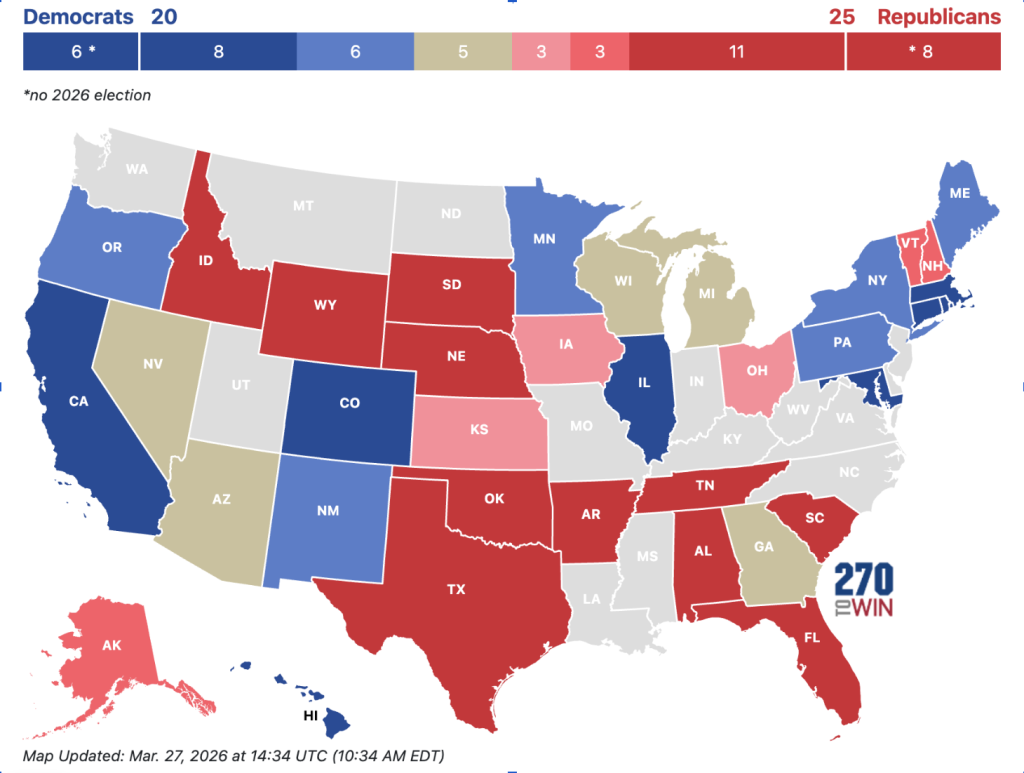
Governors in states like Michigan, Wisconsin, and Arizona are already serving as a frontline defense against federal overreach, using their executive authority to push back on immigration enforcement, protect reproductive rights, and shore up public health infrastructure. In 2026, Democrats have a real chance to expand that firewall.
In Nevada and Georgia, open-seat races give Democrats a chance to pick up governor’s mansions in states that will be critical in 2028. In Wisconsin and Michigan, the goal is to hold ground and cement the power of a state executive willing to use every tool at their disposal. Kansas and Ohio represent longer shots, but in this environment of political instability and rising frustration with Republican leadership, neither state should be written off.
Governor Elections
State Legislatures
Although gubernatorial races may grab bigger headlines, state legislatures are where policy is made. Legislative leaders draw congressional districts, control state budgets, set policies on education, reproductive healthcare, and economic agendas.
Here, the math is encouraging: Democrats just need to flip a handful of seats in several states to break supermajorities, gain governing power, and block authoritarian legislation. In Michigan, Democrats are looking to win back the State House, while Pennsylvania’s closely divided Senate offers Democrats the opportunity to secure a trifecta. In Wisconsin, newly drawn maps give Democrats their first genuinely competitive state legislative map in over a decade.
State Senate:
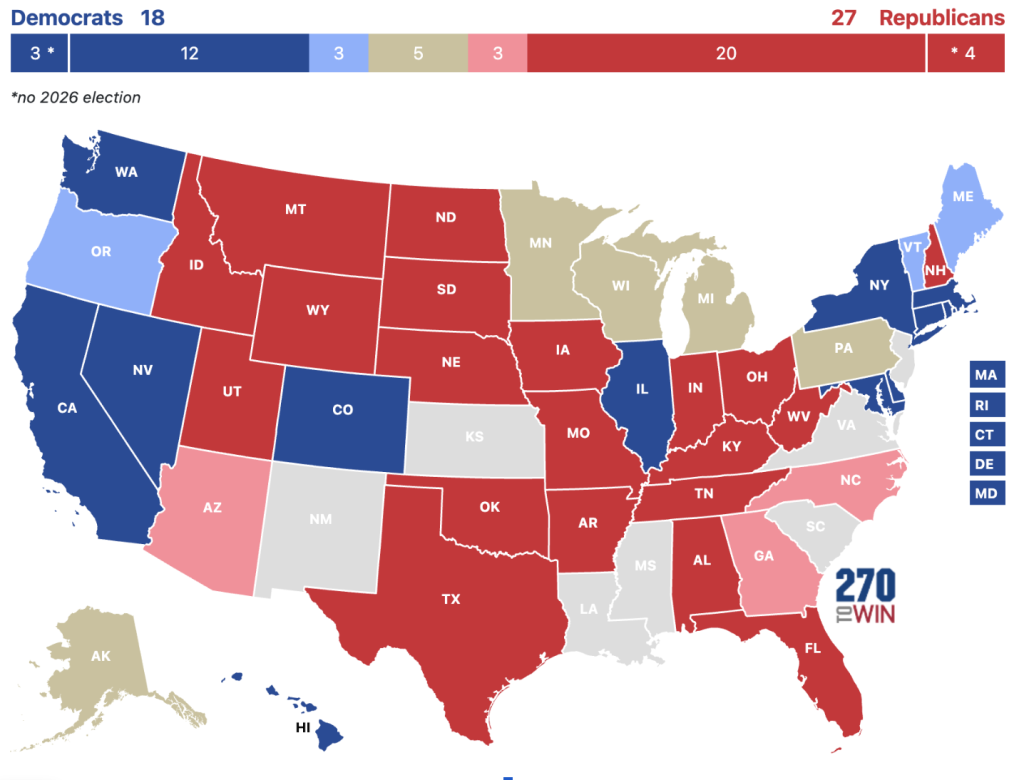
State House:
Broader Lessons for 2026
Winning the races above is critical to avoid losing our democracy for a generation or more. However, winning the midterms alone will not secure the future of our democracy. In order to build and wield durable power, it is imperative that we learn and practice broader lessons critical to our ability to make our voices heard and influence governance regardless of who is in power.
- Give Earlier: The most common mistake donors make is waiting until the final months before an election to deploy resources. By then, the most impactful work – candidate recruitment, early organizing, voter registration, and narrative-setting – should have already been done. Early money is exponentially more valuable than late money, as it allows campaigns to negotiate more favorable vendor contracts, and enables households to receive multiple touches in the run-up to the election. Early money provides the necessary runway for community coalitions to have a stronger influence on local narratives and to inspire voters to recognize their own power as key actors in our democracy. This is relevant not just in an election year but every year. While we’ve passed the deadline for the All by April Campaign, the truth is that the earlier you move money, the more of an impact it will have.
- Move Beyond Transactional Investment: The transactional model of political giving, where donors give money for specific, short-term priorities, has repeatedly failed us. It treats elections as discrete events rather than as integral components of a larger arc of sustained organizing and relationship-building. It privileges consultants and advertising over community organizing and power-building. It also ensures that the moment an election ends, the infrastructure that made victory possible begins to crumble. Moving beyond transactional investment requires longer-term commitments to communities and organizations, and multi-year investments in geographies instead of redrawing the funding map from one year to the next.
- Fund the Multi-Entity Ecosystem: No single organization, strategy, or tactic will save us. Winning requires a healthy ecosystem of organizations playing different but complementary roles: 501(c)(3) nonprofits building long-term capacity and leadership, 501(c)(4) advocacy organizations that can engage in politics and lobbying, and PACs that can drive direct electoral activity. Donors often find themselves falling into one of two camps: giving primarily 501(c)(3) dollars or investing solely in electoral races. It is important to note that 501(c)(3) funders are generally allowed to support the “primary purpose” work of 501(c)(4) organizations, and doing so helps build the ecosystem by defraying costs that would otherwise have to be paid for using hard political dollars. We encourage funders to consider leading with their 501(c)(4) giving, and then examining their capacity for complementary investments in 501(c)(3) and political entities.
- Invest in Organizing Infrastructure: The single most important lesson from 2024 is that organizing infrastructure is what endures when everything else fails. Despite federal attacks on state governing power, communities remain mobilized in Minnesota, Chicago, and Portland. This is made possible due to deep investments in local organizing infrastructure, such as the cultivation of permanent community organizations, year-round staffing capacity, leadership development pipelines that create new organizers, civic engagement programs that operate between elections, and issue-based campaigns that build power around local policy opportunities.
The midterm elections do not offer a panacea for our democracy woes, but they are an essential battleground in the fight for the soul of our nation – an opportunity to halt the erosion of democratic norms and protect our communities from persecution. The governors and legislators we elect this year will determine whether states may continue to serve as laboratories of democracy, or if they will merely serve as outposts of resistance.
2026 is sure to bring more hardship, but the path forward is clear. We can choose to succumb to the despair manufactured by this administration, or rise to meet this moment with the strategic clarity and commitment it demands. We can build the multiracial democracy our nation has always needed. 2026 is winnable – not every race, and not without difficulty – but winnable in ways that matter enormously for people’s lives and for democracy’s future.