

Left-of-center philanthropy’s ongoing struggle to adequately respond to rising authoritarianism is often framed as resulting from a combination of strategic missteps, resource misallocation, and misdirected (or missing) political will.1 There’s been some but less analysis that unpacks those struggles in terms of skills or competencies.2 This blog pulls on that thread, exploring how decades of socio-economic and political forces have reshaped the sector’s workforce – ignoring the skills3 most needed to respond to our intensifying and colliding crises effectively.
Those forces are inconspicuous, but not mysterious. Decades of neoliberalism gutted the progressive left, pushing movement infrastructure to retreat and reshape as formalized 501(c)(3)s,4 unduly elevating the power and influence of institutional philanthropy across the broader social sector.5 Market-based logic, often championed by big funders and sector influencers, colonized nonprofits and community organizations under the cloak of “professionalization,” importing language and practices – efficiency, scalability, and return on investment – into spaces that resist or are wholly incompatible with those frames.6 Management consulting’s hegemonic ascension7 spilled into the social sector, elevating technocratic aptitude8 and rewarding the production of polished (yet often abstruse) frameworks, reports, and data systems – crowding out or ignoring the role of relational and community-based practices.
A century of vocationalization diminished liberal arts traditions in higher education, reconfiguring its telos in collective life and public consciousness.9 The primacy of technical skills, career readiness, and specialization hit the humanities particularly hard, reducing the number of folks with training in traditions – philosophy, history, literature, and political theory – that orient people to both question power and value justice.10
Last but certainly not least, endless-growth logic and white supremacist cultural norms11 canonized urgency, output, measurement, anti-vulnerability, and apoliticism in “professional” spaces, narrowing what constitutes competence, professionalism,12 or acceptable conduct.13
The confluence of these forces has resulted in philanthropy overindexing skills underlying project cycles, due diligence, research and analysis, and convening (rather than mobilizing) stakeholders, and over-rewarding those implicated in reputational risk management, political maneuvering, marketing and PR, and conflict diffusion or suppression.
To be clear, most of these are valuable skills, no doubt. And, if leveraged in proper balance with other less emphasized skills, most are valuable for navigating our current polycrisis, too. However, they are not organizing, relational intelligence, critical analysis, power-building, network-weaving, nor trust-building – the skills14 necessary to build coalitions, transform narratives, shift institutions, disrupt systems, or contest strategic terrain.15
This dynamic – how skills are either valued or distributed in imbalanced ways throughout the sector – shows up regularly in my own work. In more moderate, slightly left-of-center spaces, I see it manifest as wholesale confusion or fundamental disagreement about why we are losing. In more progressive contexts, there tends to be a robust understanding of what’s needed, but flares up as barriers when attempting to scale or implement solutions (sometimes because those scaling or implementation visions entail collaborating with less progressive groups).
Beyond particular organizational contexts, I am personally an example of this dynamic: my formative experiences and training in the sector led to over-allocating my effort and time towards technical skill development (social science fluency, program/learning design, the “fundamentals” of grantmaking, grounding arguments or persuasion efforts in subject matter expertise, etc.). Further, I’ve struggled at times with relational or organizing aspects of the work, not because I disliked those areas or was opposed in any way. Rather, I think, because those formative experiences collided with core identity dimensions and privileges (e.g., introversion, whiteness, class dynamics, cultural anchors, etc.), thereby creating propensities for particular knowledge domains and tilted assessments about what was important or valuable. This played out so that, early in my career, I mostly invested the time and energy to know about organizing, power-building, critical analysis, etc., but not enough time practicing, internalizing, or embodying those skills. I’ve spent recent years trying to catch up.
The result is a sector actively selecting against the skills it has needed far more of for decades – our polycrisis has merely reified and underscored them.
I suspect that much of the sector’s workforce is like me: doing what their formation prepared them to do and what institutional incentives reward. Unfortunately, those formations and institutional incentives are propelled by socio-political, economic, and cultural forces that mutually reinforce one another. The result is a sector actively selecting against the skills it has needed far more of for decades – our polycrisis has merely reified and underscored them.
That’s a tough reality to accept – one we can’t and shouldn’t accept. So, what do we do? At risk of oversimplifying things, here’s what I suggest: cultivate the skills and competencies – organizing, relational intelligence, critical analysis, power-building, network-weaving, and trust-building – that the sector needs more of. On that front, there are specific hopeful examples, including Rajasvini Bhansali’s thoughtful argument that organizing is a skill that can be learned like any other skill, or Isabelle C. Hau’s recent call and framework for more seriously valuing and investing in relational intelligence (and, more broadly, building the capacities “essential to human flourishing”).16
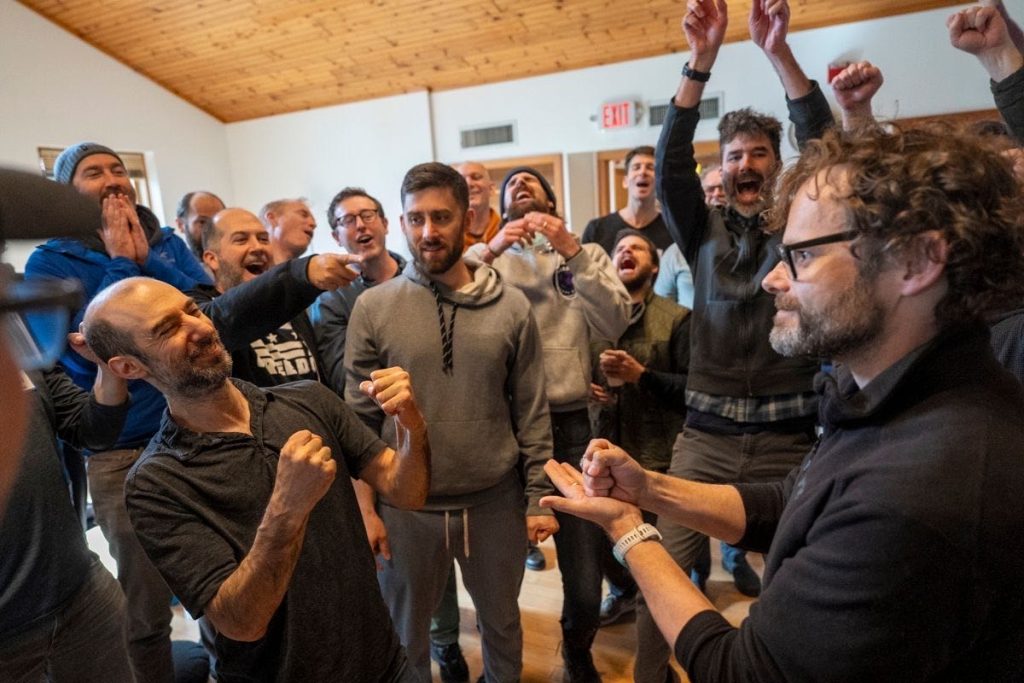
In work I’ve been directly connected to, I’ve been particularly inspired by the Perennial Sunflower Project, which is building the ecosystem of organizations and leaders working to help white men and boys find belonging, meaning, and purpose in existing efforts for racial, gender, economic, and environmental justice. As their work has grown, they’ve had to grapple with how – and how fast – to grow the donor and funder organizing dimension of their work. Throughout, they’ve deftly navigated when to bring individuals, organizations, and coalitions into the fold by prioritizing movement orientation, long-term relational work, and trust-building over other, more typical priorities for growing infrastructure organizations (e.g., accumulating social capital, scaling fundraising capacity, and polishing strategy or case statements). On a personal front, this community has deepened my understanding and comfort with these key skills – organizing, power-analysis, network weaving – and sharpened the way I approach much of my core work at Ktisis.
With that said, there’s clearly more work to be done. The scale of the problems we face is daunting: the forces that have shaped this skill imbalance are inextricable from those propelling the rapid socio-political degeneration that the philanthropic left is presently inadequately responding to. The totality of that challenge – the sprawl of the crises we face – can easily conjure feelings of helplessness. However, as many brilliant sector leaders and colleagues have argued, the essential ingredients to meeting that challenge – the skills and competencies underlying organizing, power-analysis, trust-building, etc. – are cultivatable. That framing, hopefully, conjures motivation as easily as our present polycrisis conjures despair.
- There are many important examples, both contemporary (e.g., How We Got Here: Six Reasons Liberal Philanthropy Is Losing the Battle for America’s Future; A Bigger We: A strategy to foster the belonging, bridging & building of collective agency needed to revitalize our democracy; It’s Time for Left-Leaning Funders to Fully Fund and Engage in Political Warfare) and from the more distant past (e.g., Moving a Public Policy Agenda: The Strategic Philanthropy of Conservative Foundations; Progressive Think Tanks: What Exists, What’s Missing?). ↩︎
- Throughout this blog I treat the terms skills, competencies, and abilities as roughly equivalent, but there are important nuanced differences between them (e.g., see: Typology of knowledge, skills and competences; What is competence?; and Doing Competencies Well: Best Practices in Competency Modeling.).
↩︎ - The sector inconsistently uses these and other terms (capacities, competencies, skills, capabilities, etc.); sometimes they appear interchangeable, other times as connected but distinct, either explicitly or implicitly (e.g., capacity appears more frequently when describing higher levels of abstraction – teams, organizational functions, ecosystems – whereas skill tends to describe individuals). That inconsistency is worth exploring further but, unfortunately, there’s not enough space here to do that properly. ↩︎
- Tom, A. (2025). “On Big Money and Movement Economics,” in Free the People to Free the Money to Free the People. ↩︎
- Luo, N. (2025). “Left organizing is in crisis. Philanthropy is a major reason why,” in Free the People to Free the Money to Free the People.
↩︎ - Eikenberry, A. M., & Kluver, J. D. (2004). The marketization of the nonprofit sector: Civil society at risk? Public Administration Review. ↩︎
- McKenna, C. D. (2006). The world’s newest profession: Management consulting in the twentieth century. Cambridge University Press. ↩︎
- Tompkins-Stange, M. E. (2016). Policy patrons: Philanthropy, education reform, and the politics of influence. Harvard Education Press. ↩︎
- Pew Research Center. (2016). The state of American jobs: The value of a college education. ↩︎
- Nussbaum, M. C. (2010). Not for profit: Why democracy needs the humanities. Princeton University Press.
↩︎ - Jones, K., & Okun, T. (2001). “White supremacy culture,” in Dismantling racism: A workbook for social change groups. ChangeWork. ↩︎
- Gray, A. (2019). The bias of “professionalism” standards. Stanford Social Innovation Review. ↩︎
- See Vanessa Machado de Oliveira’s “HEADS UP” framework in Hospicing Modernity. ↩︎
- While not framed exactly in these terms, this imbalanced distribution of skills echoes important insights across recent sector discourse, unpacked as: completely reimagining the sector’s capacity-building orthodoxies (Reimagining Nonprofits and Philanthropy); redefining giving as a fundamentally relational, collective, and community-grounded activity (The Big We; Transformative Donor Organizing); rejecting conceptions of relational or reciprocal practices as incidental “soft skills” and, instead, celebrating and embracing them as essential field paradigms (Decolonizing Wealth); more deeply investing in ideological development without forgoing the technical skills required to execute strategies (Building Resilient Organizations); and recognizing, resourcing, and scaling the leadership and skill of women of color leaders, who face unique precarity in this work due to sector conditions (Unrig the Game). ↩︎
- Especially with an opponent that has spent decades investing in those very competencies (and, for those they haven’t invested in, they compensate by having different values or power structures that enable circumventing work that the left essentially has to do). ↩︎
- There are many promising approaches detailed in the resources linked in footnote 14, all situated in comprehensive diagnoses of and proposed solutions to the deep challenges the sector faces. ↩︎